
- In this post: quick ways to notice wind + cloud movement on your next hike
- Not in this post: the full cross-check framework, seasonal variations, and the illustrated practice sequence (that’s in the book)
The fastest way to get lost isn’t a wrong turn—it’s a narrowed mind. When your attention shrinks to a screen, the world becomes background noise, and you miss the obvious truths the sky is calmly announcing. But when you widen your awareness, navigation stops being a problem you solve and becomes a relationship you keep.
Wind, weather, and sky don’t just decorate a hike—they shape it. They influence comfort, safety, visibility, pace, and even decision-making. Learn to read them, and you’ll walk with a steadier sense of direction and timing—whether you use GPS or not.
Why Wind, Weather, and Sky Matter in Navigation
Wind and sky are continuous signals. They’re always “on,” always updating—long before an app refreshes or a forecast proves wrong for your exact valley.
They matter for two big reasons:
- Direction & orientation: They help you keep a “big picture” sense of where you’re moving and how the landscape is arranged.
- Safety & judgment: They warn you early—about exposure on ridges, incoming rain, temperature drops, storms building, or visibility collapsing.
A helpful mindset: GPS can tell you where you are. The sky often tells you what’s coming.
Basic Wind Signals to Observe
Reading wind direction by feel and observation
Wind is the simplest teacher because you can feel it immediately—on your cheeks, ears, forearms, and even in your breath.
Try these quick methods:
- Face test: pause, close your eyes, and slowly turn until you feel the strongest pressure/coolness on your face.
- Leaf/grass release (gentle): drop a dry leaf or a blade of grass from shoulder height and watch its initial drift (not where it tumbles).
- Treetop watch: look at upper branches rather than ground-level flutter—treetops often show the steadier flow.
- Water texture: on ponds/lakes, wind writes its direction in ripples and streaks.
Pro tip: wind near the ground is messy. The “real” direction is often clearer a little higher up.
Wind patterns and what they tell you about landscape and weather
Wind doesn’t blow through terrain—it negotiates it. Valleys funnel it. Saddles accelerate it. Ridge tops expose you to it. Forest edges break it into turbulence.
What wind can tell you on a hike:
- Where you are in the terrain: strong, steady wind often means you’re more exposed (ridge, open slope, coastline).
- Where shelter is: the leeward sides of ridges (downwind) are calmer and warmer.
- Weather shifting: a noticeable wind shift can signal a front, storm development, or a change in pressure.
Use wind as a clue, not a conclusion. It’s excellent for awareness—but unreliable as a lone “compass.”
Sky and Cloud Patterns as Navigational Tools
Identifying cloud types and movement
You don’t need to become a meteorologist. You just need a few “big shapes” and a habit of watching movement over time.
A beginner-friendly cloud cheat sheet:
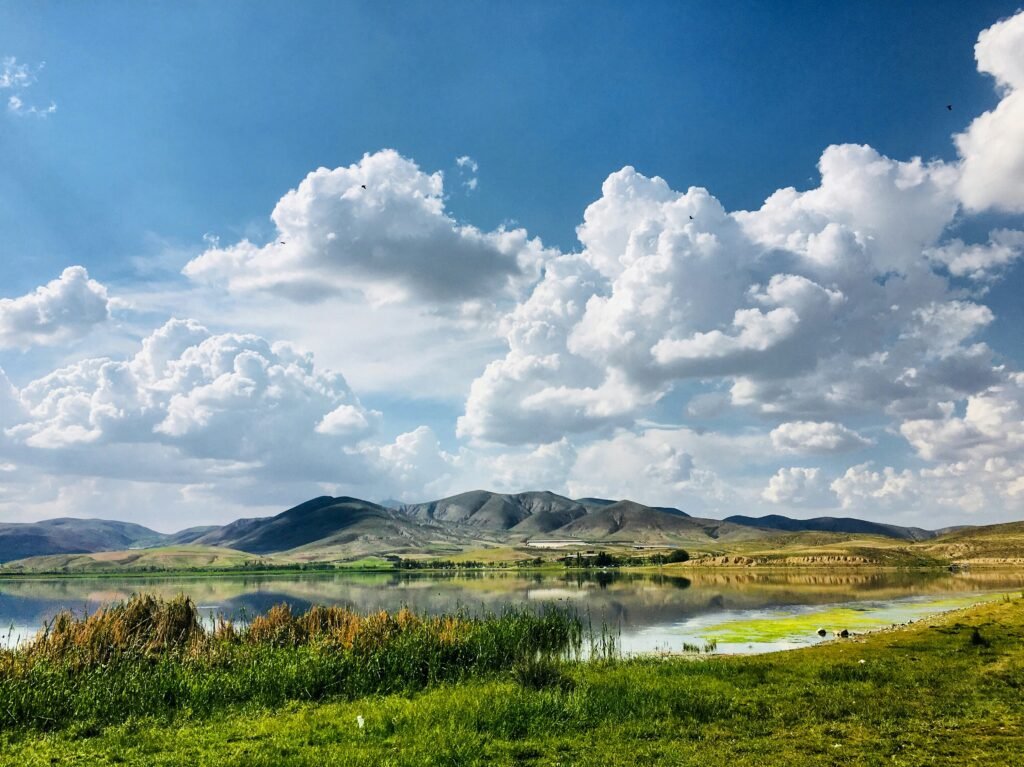
- Cumulus (puffy cotton): often fair weather, especially if they stay small and well-spaced. If they grow tall and dark underneath, the weather may be building.
- Stratus (flat layer/blanket): can mean stable, grey conditions; sometimes drizzle or reduced visibility.
- Cirrus (high wisps): can be an early hint of change; often appears ahead of incoming systems.
Movement matters more than labels. Watch cloud drift for 2–3 minutes, then check again 15 minutes later. You’re training “sky patience,” which is a real navigation skill.
Using the sun and stars to determine direction
For hikers, celestial cues are most useful for maintaining overall orientation, not for pinpoint accuracy. Sun basics (simple and practical):
- The sun generally rises in the east and sets in the west, but the exact points shift through the seasons.
- Around midday, the sun is generally south in the Northern Hemisphere and north in the Southern Hemisphere (not exact, but helpful).
Night basics (only if you’re comfortable and conditions allow):
- In the Northern Hemisphere, Polaris (North Star) sits roughly above north.
- In the Southern Hemisphere, you can use the Southern Cross region to approximate south.
If you want a clean, device-free way to find direction using the sun, start with the free guide here: Shadow Stick Compass Guide.
Weather Changes to Watch For
Recognising weather shifts and what they mean
On a trail, weather changes don’t arrive as headlines—they arrive as textures.
Look for:
- Light change: brighter glare turning to flat, grey illumination can indicate cloud thickening.
- Wind shift: a change in wind direction or a sudden strengthening can signal a front.
- A temperature drop, especially when paired with wind, can quickly affect comfort and safety.
- Cloud growth: puffy clouds stacking upward (more vertical) can indicate building instability.
Preparing for sudden changes during outdoor activities
Practical preparation isn’t fear—it’s respect.
- Add a simple habit: “pause and look up” every 20–30 minutes.
- Know your exit options (turnaround points, trail junctions, sheltered routes).
- Be conservative with exposed ridges if the sky is “telling a new story.”
- If visibility is dropping, simplify decisions: stay on clear trails, avoid shortcuts.
Natural navigation isn’t only about direction. It’s also about timing.
Practical Tips for Developing Weather Sense
Daily observation habits
Weather sense grows through repetition, not intensity. Small daily noticing compounds.
Try:
- One-minute sky check each morning: cloud type, movement direction, brightness.
- Wind note when you step outside: direction + strength (gentle/steady/gusty).
- Evening recap: “What changed today, and when did it start?”
This is how you build a calm inner library of patterns—without making it complicated.
Integrating sensory cues for fuller awareness
Your body is a subtle instrument. Don’t romanticise it—just use it.
Notice:
- How wind changes when you move from forest to open ground
- How air feels near water vs. on sunlit rock
- How sound carries differently when humidity changes
- How your pace shifts when you’re walking into the wind vs. with it
Then, if you want, use GPS briefly as a confirmation tool—not the driver.
To explore this kind of observation-led navigation further, your book page is here: The Art of Reading Nature.
Common Myths About Wind and Weather Navigation
Myth: “Wind always blows from the same direction.” Reality: local terrain bends wind constantly. Learn the difference between prevailing wind and local gusts. Myth: “A single sign (cloud type, moss, wind) tells the truth.” Reality: nature is context. Cross-check wind + sky + terrain + time. Myth: “If the forecast said X, the hike will be X.” Reality: forecasts are regional; your valley, ridge, coastline, and canopy create micro-weather. Myth: “Natural navigation is only for experts.” Reality: beginners can learn it fastest because it starts with the simplest skill: paying attention.
Try This on Your Next Walk (10–20 minutes)
- Wind direction check: note the wind using leaves/grass/treetops, then compare with your GPS compass heading (just as a confirmation).
- Cloud movement study: watch one cloud group for 2 minutes, then repeat after 15–30 minutes—note direction and speed changes.
- Temperature shift awareness: notice if the air cools as clouds thicken or wind increases; write a one-line note in your phone: “cooler + windier at 3:10 pm.”
- Terrain + wind pairing: stand on each side of a small hill or ridge and feel the difference between windward/leeward.
Common Mistakes (and how to avoid them)
- Relying too heavily on a single cue
Fix: cross-check wind + sky + terrain. If two out of three disagree, pause.
- Confusing local gusts with prevailing wind
Fix: watch treetops or cloud drift for steadier direction.
- Misidentifying cloud movement (or focusing only on shape)
Fix: movement over time matters more than naming the cloud correctly.
- Assuming “my phone knows best”
Fix: treat GPS as confirmation; let the sky inform your decisions about exposure, timing, and visibility.
FAQ
Can wind direction help me find north?
Sometimes it can support your overall orientation, but wind is not a reliable north-finder by itself. Always cross-check with sun/shadow, landmarks, terrain, and (when appropriate) map/compass.
What clouds indicate fair weather?
Often, small, well-formed cumulus on a clear day suggests stable conditions. If clouds grow taller, darker underneath, or spread into thicker layers, the weather may be changing.
How fast do weather patterns change in the wild?
It’s variable. Terrain and microclimates can shift conditions quickly—especially near mountains, coasts, and large bodies of water. Practice frequent “look up” check-ins.
Can I use sky cues at night?
Yes—stars and the moon can provide general direction, depending on the hemisphere and visibility. Keep it simple, and always use backups when navigating in the dark.
Want to deepen your weather awareness and feel more oriented without constantly checking a screen? Explore the natural navigation approach in The Art of Reading Nature. Download the free Shadow Stick Compass Guide to start practising direction-finding with the sky—simple, grounded, and repeatable – Shadow Stick Compass Guide.