
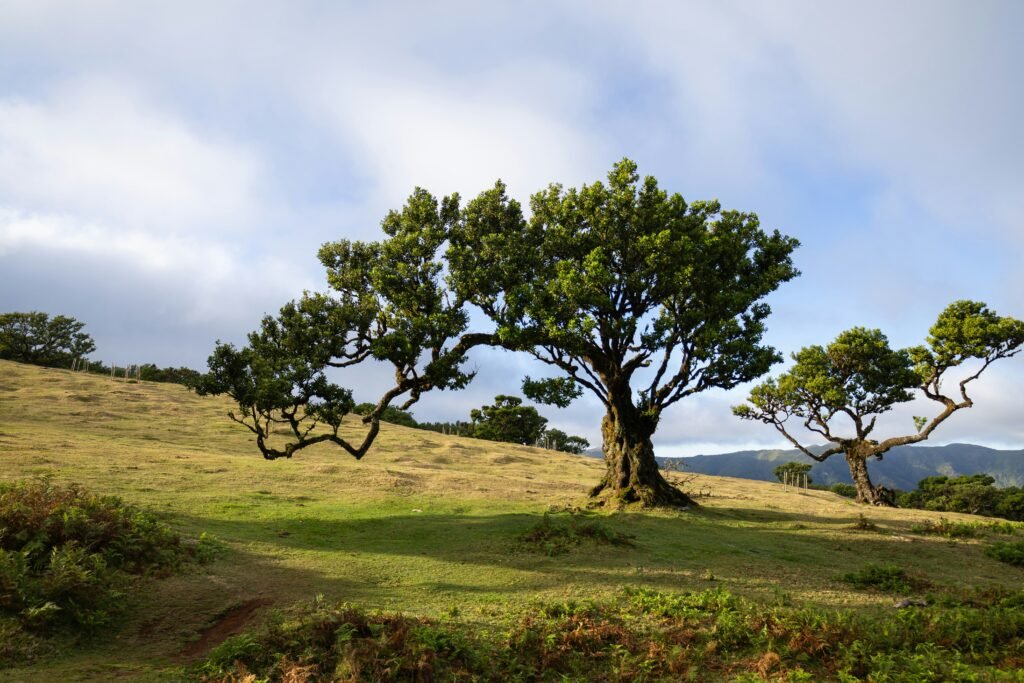
There’s a way of walking where the forest becomes more than “trees.” The land stops being a backdrop and becomes a conversation—subtle, ongoing, and surprisingly practical. But the moment we try to turn living things into rigid rules (“moss equals north,” “lean equals wind,” “this plant means that”), we lose both accuracy and respect.
Trees and vegetation can help you stay oriented—especially as supporting clues—but only if you read them the way you’d read any good guide: with humility, context, and cross-checking.
In this post
- How trees and vegetation can offer directional hints and terrain context
- How to use plant clues without overconfidence
- A simple, ethical “field method” you can practice on your next walk
Not in this post (covered in the deeper system in the book)
- A complete, illustrated cross-check framework for resolving conflicting signs
- Seasonal/terrain-specific reliability rankings (what to trust where)
- A progressive practice path that builds skill week by week
Explore the full method in The Art of Reading Nature.
What Trees and Plants Reveal About the Environment
Trees and plants don’t point like arrows. They respond to light, wind, slope, water, soil, and disturbance. That response can become a clue.
Tree lean, moss growth, leaf orientation
Tree lean
- Lean can reflect prevailing wind, snow load, slope creep, or past damage.
- A single leaning tree tells you very little.
- A pattern across many trees can tell you more—especially in exposed areas.
Moss and lichen
- Moss often thrives where it’s moister and shadier—which may correlate with a particular side of trunks/rocks in some settings.
- But moisture and shade are local: gullies, stream edges, canopy density, and aspect can override “north side” myths.
Leaf/canopy shape
- In open areas, canopies may grow fuller toward better light.
- In tight forests, competition distorts growth; “light direction” becomes less clear.
Relationship between vegetation and terrain or sun direction
Vegetation is often better at revealing terrain and moisture than cardinal direction.
Look for:
- Lusher growth where water collects (drainages, seeps, valley bottoms)
- Drier, tougher plants on ridges and exposed slopes
- Sharp transitions that may indicate a change in aspect, elevation, soil, or exposure
For hiking navigation, that matters because terrain is the “big truth” beneath everything. If you can read where the land is wet, steep, open, or sheltered, you navigate with fewer surprises.
Understanding Limitations and Variability
Plant signs are real—but they’re not universal.
How seasonal changes or animal damage affect cues
- Seasonality: leaf loss, growth spurts, and dieback change what you can read.
- Storm history: wind events can create misleading lean or broken crowns.
- Animal browsing: can alter vegetation height and density.
- Human impact: trail widening, clearing, and campsites change growth patterns.
Avoiding overreliance on single plant signs
A reliable approach is triangulation:
- Never decide direction from one clue (moss, lean, canopy).
- Look for agreement between multiple signs:
- vegetation patterns + terrain logic + sky/sun cues
- When signs conflict, trust the bigger-scale signal (terrain and sky) over the micro-scale signal (one trunk’s moss).
Ethical Considerations in Using Vegetation for Navigation
Natural navigation should deepen relationship, not extract from it. Ethical skill is lighter on the land.
Low-impact guidelines (hiker-simple):
- Observe—don’t harvest. No stripping moss/lichen, no peeling bark, no breaking branches.
- Don’t mark living trees to “help on the way back.” Use your mind and your map instead.
- Stay on durable surfaces when pausing to study (trail, rock, dry ground).
- Be extra careful in sensitive habitats (alpine zones, wetlands, fragile forest floor).
- If you’re teaching others, model “look, don’t take.”
A good rule: if your navigation method leaves visible damage, it’s not a method—it’s a footprint.
Practical Techniques to Observe Trees and Vegetation
Noting tree lean relative to wind and moisture
Use this simple pattern-reading method:
- Find an area with similar exposure (same ridgeline or open slope).
- Pick 10–20 trees (not one).
- Ask:
- Do most lean the same way?
- Is the lean stronger near the ridgeline (more wind exposure)?
- Does the lean change near gullies (more shelter, more moisture)?
Only then treat it as a supporting clue.
What you’re really learning: not “lean equals direction,” but “exposure creates patterns.”
Using moss placement with cross-checking methods
Instead of “moss = north,” use a better question:
- “Where is it moister and shadier here, today?”
Practical steps:
- Compare moss on multiple trunks/rocks in the same micro-area.
- Note nearby influences:
- stream/seeps, dense canopy, shaded rock faces, hollows
- Cross-check with a more stable cue:
- sun position/shadow, terrain aspect, or a compass/map
If you want a simple, repeatable sun-based direction method to cross-check plant cues, start with the free Shadow Stick Compass Guide.
Cross-Checking Plant Indicators with Other Natural Signs
Trees and vegetation become far more useful when they’re part of a set.
A simple cross-check stack for hikers:
- Terrain first: ridges, valleys, drainages, slope direction (the “big shape”)
- Sky second: sun position, cloud movement, wind feel (the “moving context”)
- Vegetation third: exposure/moisture patterns as supporting evidence
- Optional tools: map/compass/GPS for confirmation (especially at junctions)
Combining terrain, sky, and animal signs
An animal sign can add context, especially around water and corridors:
- Tracks and scat often concentrate along natural lines of travel
- Bird activity and insect density can hint at water nearby
- Game trails may indicate easier contours—but don’t confuse them with human trails
Use animal sign as environmental context, not as a reliable directional arrow.
Common Myths About Moss and Tree Navigation
Myth: “Moss always grows on the north side.”
Reality: Moss grows where conditions suit it—often moisture and shade. Sometimes that aligns with a particular side; often it doesn’t. Treat moss as a microclimate clue, not a compass.
Myth: “Tree lean tells you the prevailing wind direction everywhere.”
Reality: Lean can be caused by many forces (slope, snow load, past damage). Only patterns across many trees in similar exposure are meaningful—and even then, it’s a hint, not a guarantee.
Myth: “You can navigate reliably using plants alone.”
Reality: Vegetation helps most when it supports bigger signals (terrain + sky). The land is a whole system; your navigation should be, too.
Try This on Your Next Walk (10–15 minutes)
- Lean pattern check: pick 15 trees on an open slope and note the dominant lean direction (if any). Then move 100–200 meters into more shelter and see if the pattern changes.
- Moss reality test: observe moss placement on 5–10 trunks/rocks. Write down what else could explain it (shade, water, canopy density).
- Midday shadow cross-check: around midday, notice the shadow direction and compare it to your vegetation “guess.” (If you want a clean method for this, use the Shadow Stick Compass Guide.)
- Terrain + plants: identify where you think water would flow; then confirm by noticing which plants look moisture-loving vs drought-tolerant nearby.
Common Mistakes (and how to avoid them)
- Assuming all moss grows on the north side
Fix: treat moss as moisture/shade; cross-check with sun/shadow and terrain.
- Ignoring environmental factors (shade, water, canopy, rock faces)
Fix: ask “what local conditions are shaping this?” before assigning direction.
- Relying on one tree or one plant
Fix: look for patterns across many trees in the same exposure.
- Forgetting ethics when “testing”
Fix: no stripping, breaking, carving, or disturbing habitats—observe only.
- Letting a clue override the bigger picture
Fix: terrain and sky outrank micro-signs when they disagree.
FAQ
Does moss always indicate north?
No. Moss varies with moisture and light conditions, which can differ tree to tree and slope to slope. Use it only as a supporting clue.
Can I use tree lean for accurate navigation?
It can serve as a pattern clue in some landscapes, but it’s not accurate enough on its own. Cross-check with terrain and sky cues (and tools when needed).
What vegetation changes with seasons affect navigation?
Leaf loss, new growth, dieback, and shifting ground cover can all change what’s visible and how reliable patterns feel. Treat each season as a new “edition” of the landscape.
How do I remain respectful while using plants as indicators?
Observe without disturbing: don’t harvest, don’t damage, don’t mark. Keep your learning light on the land.
Curious about reading plant signs without falling into myths or overconfidence? The whole, illustrated cross-check approach is laid out in The Art of Reading Nature. Start with a reliable foundational skill: download the Free Shadow Stick Compass Guide and use it to cross-check what trees and vegetation suggest.