
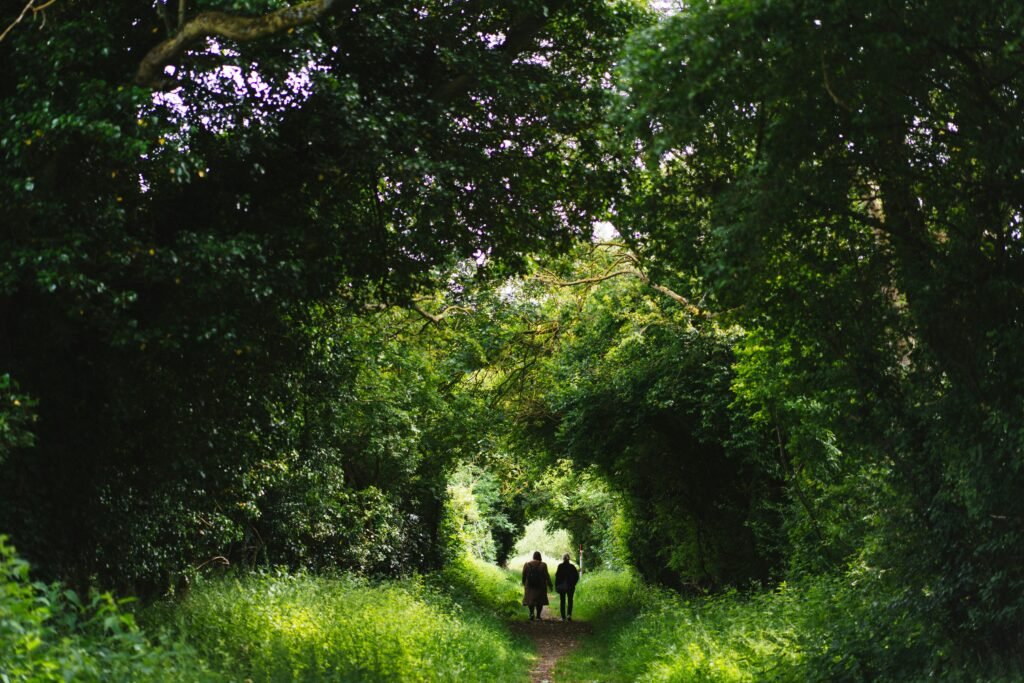
Most people try to learn navigation the way they try to learn fitness: in bursts. A weekend of enthusiasm, a handful of tips, then back to autopilot. But natural navigation isn’t primarily “information.” It’s familiarity. It’s the difference between knowing a place exists and knowing how it feels to move through it.
A weekly routine works because it trains what the modern world de-trains: sustained attention. Not intense attention—just steady attention. The kind that makes you look up without forcing yourself. The type that notices the wind shift before the rain arrives. The kind that quietly knows which way you’ve been trending, even if you haven’t checked a screen in twenty minutes.
This is a simple, beginner-friendly weekly practice for hikers, trekkers, and trail runners—practical, not too technical, and designed to fit real life.
In this post
- A simple 7-day routine (with 10–20 minute practices)
- Daily “micro-skills” for wind, sky, terrain, vegetation, and animal sign
- A way to integrate GPS without becoming dependent on it
- Common mistakes that make practice fall apart (and how to avoid them)
Not in this post (covered in the deeper system in the book)
- A full, illustrated cross-check framework for when cues disagree
- A structured progression of drills that levels you up step-by-step
- Scenario walkthroughs (fog, storms, complex terrain) with decision trees
For the complete method and practice progression, see The Art of Reading Nature.
Why a Weekly Practice Matters
Natural navigation deteriorates if you rely on it only in emergencies. Like any skill, it’s retained through contact.
Benefits of regular observation:
- You build a baseline for “normal” conditions—so changes stand out quickly
- Your orientation improves without effort (less “Where am I?” anxiety)
- You rely less on constant checking, which reduces mental fatigue
- You become safer by being earlier: you notice problems sooner (weather, terrain drift, timing)
The secret advantage is subtle: practice gives you confidence without bravado. You don’t feel certain because you’re guessing harder. You feel certain because you’ve been paying attention longer.
Structuring Your Weekly Routine
This routine has two layers:
- Focused micro-sessions (10–20 minutes): one primary cue per day
- Casual engagement (your regular walks/hikes): keep it relaxed, integrate lightly
The rules that make it sustainable
- Keep it short. Ten minutes is enough.
- Do it in familiar places. Parks, local trails, even a short loop—familiarity accelerates learning.
- Write one note. Just one. A sentence, a bullet list, or a quick photo with a caption.
- Cross-check occasionally. Confirm your sense with a compass/GPS/map, but don’t live inside it.
If you want a simple, reliable sun-based direction method to anchor your practice, start with the free Shadow Stick Compass Guide.
Day 1: Wind and Weather Observation
Goal: feel direction and change—without needing to “know the answer” perfectly.
10–15 minute practice
- Stand still for 30 seconds and feel the wind on your face/ears/forearms
- Walk a short segment and notice how the wind changes near:
- open ground vs trees
- ridges vs gullies
- corners, saddles, and gaps
- Look up: note cloud movement speed and direction (even if you can’t name clouds)
One-note journal prompt
- “Wind felt like ____ (steady/gusty/variable) from ____ (left/right/front). Sky looked ____.”
Cross-check (optional): glance at your GPS compass heading to confirm what “into the wind” means in degrees today—then put it away.
Day 2: Sky and Light Reading
Goal: build a sense of direction and timing using light—without turning it into a math problem.
10–20 minute practice
- Note where the sun is in the sky right now
- Watch shadows for 2 minutes (your shadow, a tree’s shadow, a signpost shadow)
- Observe cloud layers: thin/high vs thick/low, fast vs slow
One-note journal prompt
- “Light is ____ (sharp/flat). Shadows point _____. Clouds moving ____.”
If you want a practical, repeatable way to use shadows for direction-finding, the Shadow Stick Compass Guide is a great starting point.
Day 3: Terrain and Vegetation Awareness
Goal: upgrade from “I’m on a trail” to “I understand the shape of the land.”
10–20 minute practice
- Identify the “big shapes” around you:
- ridge line
- valley or drainage
- saddle/gap
- slope direction (uphill/downhill)
- Notice vegetation as environmental information:
- damper pockets vs drier ridges
- shade-heavy zones vs open sun zones
- moss presence as moisture/shade (not north)
One-note journal prompt
- “The land here wants water to go _____. The sheltered side feels like _____.”
This is where navigation becomes calmer: terrain doesn’t lie; it just takes patience to read it.
Day 4: Animal Track Spotting
Goal: learn to notice movement patterns ethically—without chasing wildlife.
10–15 minute practice
- Look for tracks in soft ground: mud, sand, dust, snow
- Notice pattern, not species:
- straight travel vs wandering foraging
- single file vs scattered prints
- concentrated near edges (water, trail margins, habitat boundaries)
Ethics rule (non-negotiable)
- Observe without disturbing: no following animals, no touching signs, no trampling clear tracks.
One-note journal prompt
- “Signs clustered near ____ (water/edge/shelter). Movement seemed ____ (travel/forage).”
Animal sign helps you read where the landscape makes movement easy—but it’s supporting evidence, not a compass.
Day 5: Combining Senses and Navigation Cues
Goal: integrate cues into one coherent picture—then verify lightly.
15–25 minute practice (the “mini-navigation session”)
- Start walking without checking your phone for 10 minutes
- Keep a gentle running story:
- “We’ve been trending uphill.”
- “Wind is on my left cheek.”
- “Clouds are thickening from that direction.”
- “The drainage is dropping away to my right.”
Stop and make a prediction:
- “I think we’re roughly heading ____ (general direction).”
Confirm with a quick tool check:
- GPS compass / map / compass
Adjust your understanding, not your ego:
- you’re learning calibration
One-note journal prompt
- “My prediction was off by _____. The cue I over-trusted was ____.”
This day is when the skill becomes real. Not because you get it perfect—but because you learn what to trust here.
Day 6 & 7: Rest or Casual Engagement
Goal: keep the relationship alive without making it feel like homework.
Options:
- Take a relaxed walk and choose one cue to notice (wind, shadows, terrain, birds)
- Review your week’s notes in 2 minutes and pick one thing to repeat next week
- Do nothing—and simply keep your eyes open when you’re outside
Practice deepens when it’s sustainable. The land is patient; you can be, too.
Try This on Your Next Walk (the simplest version)
If the whole week feels like a lot, do this:
- Set aside 10 minutes to focus on one cue (wind or sky or terrain)
- Record one sentence in your notes
- Use one natural feature as orientation:
- a ridge line, a river, the sun position, a prominent landmark
- Cross-check occasionally with tools, especially at junctions or in poor visibility
Consistency is the real multiplier.
Common Mistakes (and how to avoid them)
- Skipping days and losing rhythm
Fix: schedule it like brushing teeth—small, predictable, non-dramatic.
- Rushing through exercises
Fix: slow down for 2 minutes of stillness; that’s where perception sharpens.
- Not cross-checking when needed.
Fix: verify at junctions and significant terrain changes; don’t wait until you feel lost.
- Turning practice into performance (“I should be better at this”)
Fix: treat it as calibration, not judgment.
- Using GPS constantly “to be safe”
Fix: use GPS as confirmation, not as continuous steering—your awareness is part of safety.
FAQ
How long until I see progress?
Often, within a few weeks—especially if you keep it small and consistent. The first change is usually calm: less uncertainty, less compulsive checking.
Can I practice natural navigation while using a GPS?
Yes. In fact, it’s a great way to learn: predict first, confirm second. That builds skill without increasing risk.
What if I live in urban areas?
Use parks, rivers, coastlines, green corridors, and even street trees. You’re practising observation and orientation—not wilderness survival.
Is it safe to practice without tech?
It can be safe if you choose appropriate locations and keep sensible backups. Always know your limits, carry what you need, and use a map/compass/GPS when conditions demand it.
Ready to deepen your nature skills with a clear, illustrated path—not just scattered tips? Explore the full practice approach in The Art of Reading Nature. Begin with one reliable foundation: download the Free Shadow Stick Compass Guide and start practising direction-finding in a way you can cross-check and trust.
Quick takeaway
Keep practice light and repeatable. The goal is to establish a calm habit you’ll continue in week 6.
10 minutes a day beats one “big learning day.” Consistency builds a navigation sense you can trust.
Practice is observation, not ordeal. You’re training attention, not proving toughness.
Always cross-check. Use terrain + sky + common sense (and map/compass/GPS when needed).