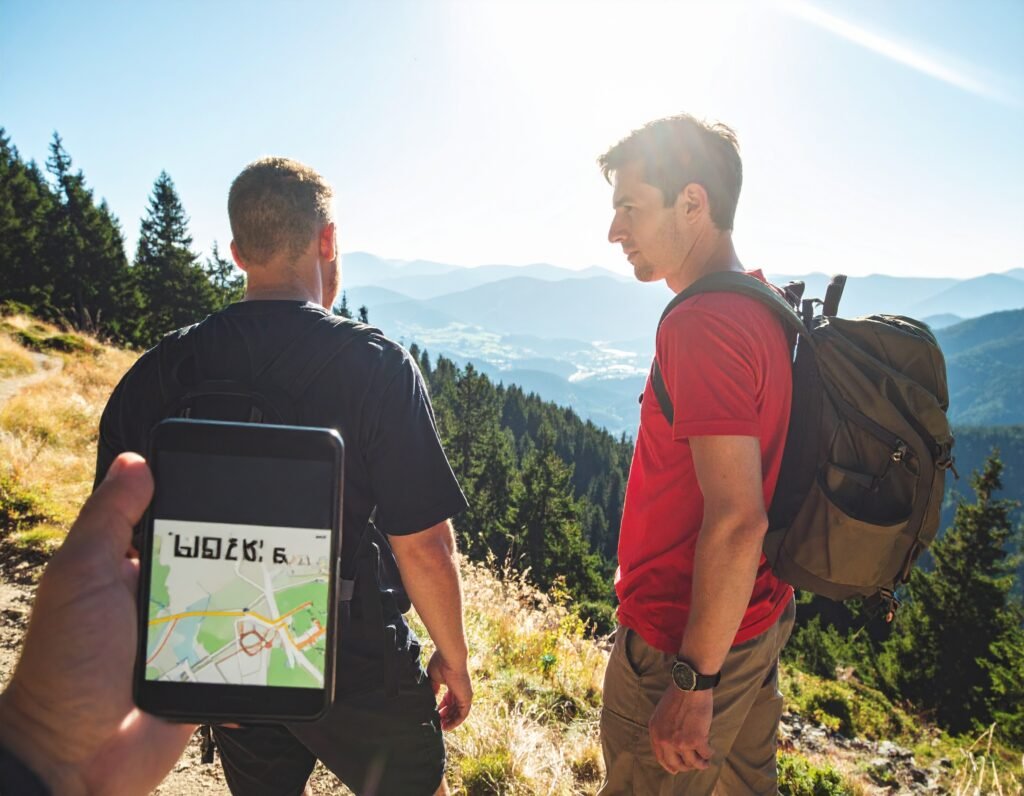
A phone can tell you your coordinates—but it can’t tell you your context.
On a good day, GPS feels like certainty: a blue dot, a clean line, a confident arrow. Yet the trail is not a line—it’s a living place, full of wind, slope, cloud, water, and the soft logic of terrain. Natural navigation isn’t a rejection of technology; it’s the recovery of attention. When you blend both, you get the best of each: fast confirmation from GPS and steady awareness from the natural world.
This article shows a practical way to hold that balance on hikes, treks, and trail runs—without getting overly technical.
Understanding GPS Navigation
How GPS devices work: benefits and limitations
GPS works by receiving signals from satellites to estimate your position. In the outdoors, that’s genuinely useful—especially when you’re tired, visibility drops, or junctions get confusing. Benefits of hiking navigation:
- Quick location checks (especially in unfamiliar terrain)
- Waypoints for key spots (trailhead, water, camp, exit points)
- Tracks to retrace your route if needed
- Offline maps (if downloaded ahead of time)
Limitations to respect:
- Batteries drain faster in cold weather and with frequent screen use
- Signal and accuracy can degrade in steep valleys, heavy tree cover, or storms
- Digital maps can be outdated, simplified, or slightly misaligned with reality
- A “correct” dot doesn’t guarantee a safe decision (cliffs, rivers, private land, storm exposure)
Dependence on technology and battery life concerns
Most GPS failures are ordinary: low battery, a cracked screen, a wet phone, an app glitch. The device is only as reliable as its weakest link. Simple battery sanity:
- Use aeroplane mode (GPS still works), keep screen time minimal
- Download offline maps before you go
- Carry a small power bank on longer days
- Treat GPS as a check-in, not constant steering
What is Natural Navigation?
Definition and core principles
Natural navigation means orienting yourself using readable patterns in the living world: sun and shadow, wind, weather, terrain shape, water flow, vegetation, and animal sign.
It’s not “guessing,” and it’s not one magic trick. It’s a habit of noticing, then cross-checking.
Core principles:
- Use more than one cue (nature speaks in a chorus, not a solo)
- Build a baseline for the day (wind, cloud movement, light direction)
- Keep a “big picture” sense of terrain (ridges, valleys, drainages)
- Update your orientation as you move, not only when you feel lost
Why it matters in outdoor settings
Natural navigation matters because it builds situational awareness—the feeling that you’re not merely in the landscape, but with it. That awareness often prevents problems before they begin.
It also improves GPS: when you already understand what the land is doing, the screen becomes confirmation rather than a command.
Advantages of Combining Both Methods
Backup and redundancy for safety
Good navigation is rarely about brilliance. It’s about redundancy.
When you combine GPS and natural navigation:
- GPS gives fast position checks and stored info (tracks, waypoints)
- Natural cues keep you oriented between checks
- If one system gets noisy or fails, the other steadies you
Enhancing situational awareness and connection with terrain
Natural navigation trains you to notice:
- whether you’re gaining a ridge or drifting into a drainage
- how the wind is being channelled by the land
- where the weather is arriving from (and how fast)
- which features can guide you back without any device
The result is simple: you feel less brittle. Less dependent. More calm.
When to Prioritise Natural Navigation
Situations where GPS may fail
Lean more heavily on natural navigation (and your backups) when:
- your battery is low, or the temperatures are cold
- reception/accuracy is unreliable (dense canopy, steep terrain)
- visibility is changing fast (fog, heavy rain, snow)
- your compass heading seems inconsistent while standing still
- the screen conflicts with what the ground is telling you
A practical rule: if GPS and reality disagree, stop and reconcile. Don’t keep walking just to “see if it sorts itself out.”
Developing fundamental observation skills
You don’t need advanced skills to benefit immediately. Start with:
- Sun awareness: where it is now, where it will be in an hour
- Wind awareness: direction on your face, and how ridges/valleys bend it
- Terrain basics: “What’s the high ground? Where does water collect?”
- Landmarks: choose features you can recognise on the return
Practical Tips for Integrating Both
Using GPS to confirm natural cues
Try this simple loop:
- Observe first (wind, sun, terrain shape, landmarks)
- Make a quiet prediction (“the trail should contour; the creek should be to our left”)
- Check the GPS briefly to confirm the position/heading
- Adjust gently (avoid over-correcting for minor GPS jitter)
This keeps you skilled even when tech is available.
Training to read wind, sky, and terrain alongside GPS data
Wind + heading pairing
- Feel the wind direction on your face
- Check your GPS heading
- Notice how the land turns wind into something local and specific
Sky + time awareness
- Notice cloud movement, light angle, and shadow direction
- Check the heading occasionally
- Let time and sky become part of your orientation, not separate from it
Terrain “story” checks. At junctions and viewpoints, ask:
- “If I had to walk out without a screen, what would guide me?”
- “Where would water run from here?”
- “What feature is ‘holding’ this trail in place—ridge, creek, contour line?”
Staying Safe in Navigation
Always carry a map and compass as a fail-safe
For real resilience, keep the classic baseline:
- a map (paper or downloaded offline)
- a compass (and basic familiarity)
- a charged phone + power bank on longer outings
- a plan (route, turnaround time, and a check-in)
Natural navigation is the human layer underneath it all: awareness, interpretation, and calm decision-making.
Know your limits and prepare for unexpected conditions
Most navigation trouble happens when:
- fatigue rises
- weather changes
- daylight fades
- you keep moving to avoid admitting uncertainty
A steady practice:
- set a turnaround time
- pause at significant terrain changes
- if unsure, stop early, not late
- choose safer options when conditions are shifting
Myths About GPS and Natural Navigation
Myth: “GPS is always better.”
GPS is often excellent—but “always” is where confidence becomes careless. Reality: GPS is best used for confirmation, especially when you already understand your terrain.
Myth: “Natural navigation is primitive.”
Natural navigation isn’t anti-modern. It’s simply awake. Reality: It’s practical for hikers because it improves your orientation continuously, even when you’re not checking a device.
Myth: “Moss (or one sign) tells you north.”
Single-sign navigation creates false certainty. Reality: Use multiple cues and cross-check—wind, sun/shadow, terrain, and landmarks together.
Try This on Your Next Walk (10 minutes)
- North check (two ways): estimate north using the sun’s position, then compare it with your GPS compass. Note the difference.
- Wind confirmation: feel wind direction; check your GPS heading as you turn corners and change aspect.
- Waypoint awareness: at a waypoint, name 3 features you could use to relocate it without GPS (ridge, creek bend, trail junction, skyline feature).
- Terrain story: pause and describe where water would flow from where you’re standing—then look around and confirm.
Common Mistakes (and how to fix them)
- Overreliance on GPS without natural cues
Fix: practice “observe → predict → confirm” and cross-check with terrain and landmarks.
- Ignoring weather/terrain changes because the app shows a line
Fix: treat GPS as information, not instruction; choose decisions based on conditions.
- Not calibrating the GPS compass.
Fix: calibrate before the hike; verify headings with landmarks or simple shadow checks.
- Checking the screen constantly
Fix: check only at junctions, significant terrain changes, or at timed intervals.
- Following a track instead of reading the ground
Fix: look up—make the landscape your primary map.
FAQ
Can I replace my GPS with natural navigation?
It’s best to use both in tandem. GPS is excellent for confirmation; natural navigation keeps you oriented and calm between checks.
How accurate is natural navigation compared to GPS?
It varies by conditions and experience. It’s most reliable when you use multiple cues and treat it as a skill of context, not a single measurement.
What if GPS signals are lost?
Pause, orient using wind/sky/terrain and landmarks, then use your map and compass as the structured backup.
How do I start learning natural navigation?
Begin with simple cues: sun position, wind direction, terrain shape, and a habit of naming landmarks. Keep it small and repeatable.
Go Deeper (Internal Links)
- Explore the book: The Art of Reading Nature — Natural Navigation Skills for Understanding the Living World.
Suggested anchors to use in the body of this post:
- “learn to read nature’s signs”
- “natural navigation skills”
- “The Art of Reading Nature”
If you like the idea of blending tech with attention—so navigation becomes steadier and more intuitive—take a look at The Art of Reading Nature. Start simple: download the FREE Shadow Stick Compass Guide, The Only Shadow Stick Method That Actually Works. (A must-have PDF outlining why standard methods fail, the background principles, and the only accurate shadow stick method—plus diagrams and uses.) You can practice finding direction in a way that builds absolute confidence.
Summary: GPS gives speed and confirmation; natural navigation gives context and resilience. Used together, they make you safer—and more present—on the trail.