
Quick takeaway (save this for your next walk)
Never disturb moss to “read it better.” Observe lightly; leave it intact.
Moss is a moisture-and-shade clue, not a compass. Treat it as context, not direction.
Patterns beat single examples. Compare moss on multiple trees/rocks before you conclude anything.
Cross-check with bigger signals. Terrain and sun/shadow are more reliable than moss alone.
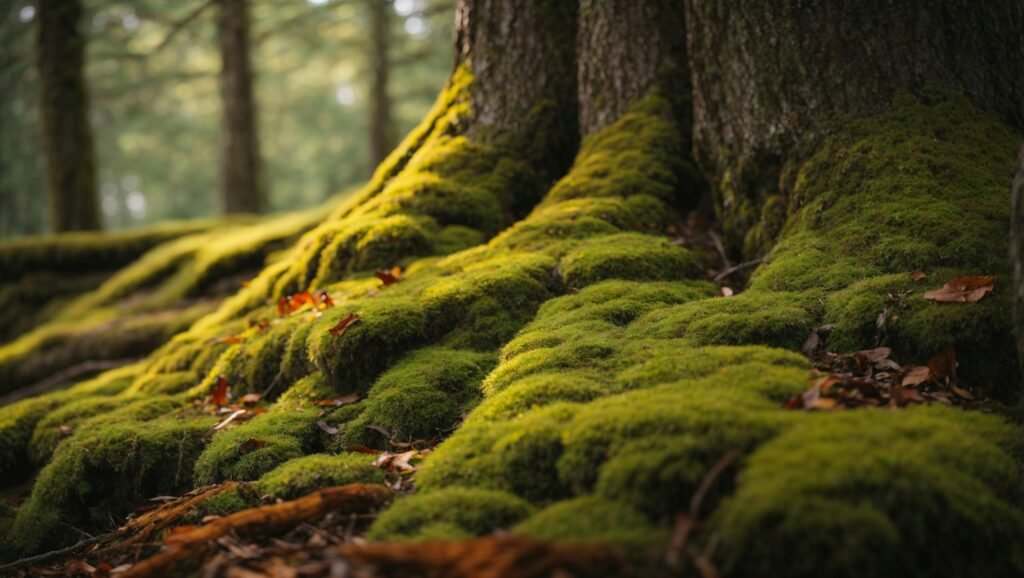
The moss myth is comforting because it promises a shortcut: look at a tree, find north, problem solved. But nature doesn’t usually speak in slogans. It speaks in conditions—moisture, shade, wind, slope, canopy, season—quiet influences that change from one side of a boulder to the next.
Moss can still be useful. Not as a compass, but as a clue about place. When you learn what moss is actually responding to, you stop asking it to do the job of a needle—and start letting it teach you the truth it’s qualified to tell.
In this post
- The most common moss navigation myths (and why they persist)
- What genuinely shapes moss growth patterns in real landscapes
- How to use moss as one clue among many—reliably and responsibly
- A simple field practice to build confidence without overclaiming
Not in this post (covered in the deeper system in the book)
- The full, illustrated cross-check framework for weighting and resolving conflicting signs
- Terrain- and season-specific guidance on which cues tend to be more reliable where
- A progressive set of exercises that turns “noticing” into a repeatable skill
That deeper method is in The Art of Reading Nature.
Popular Moss Navigation Myths
Myth 1: “Moss always grows on the north side.”
This is the classic. It spreads because it’s simple, memorable, and occasionally seems to work—just enough to convince you it’s a law. Reality: moss grows where conditions support it. In many places, the “shadier/moister side” may correlate with a particular aspect, but it’s not guaranteed—and it’s rarely clean on a single tree.
Myth 2: “Moss indicates direction reliably.”
Even when moss is more abundant on one side, it doesn’t mean that side points to a compass direction you can trust. Reality: moss is better at indicating microclimate (moisture + shade) than north. If you use it, use it as supporting evidence—never the primary decision-maker.
What Affects Moss Growth Patterns
Moss is not trying to help you navigate. It’s trying to live. Once you respect that, moss becomes more informative—and less misleading.
Moisture
Moss generally thrives where moisture lingers:
- near watercourses, seeps, damp gullies
- in areas that hold dew longer
- on surfaces that stay cool and humid
A tree near a stream can grow moss “everywhere,” which instantly breaks the myth.
Sunlight and shade
Shade is often the bigger story than compass direction:
- a dense canopy creates consistent shade in many directions
- rock faces cast long shadows that reshape local light
- the “shady side” of a trunk may be caused by nearby vegetation, not north
Terrain influences (aspect, slope, shelter)
Terrain creates microclimates:
- hollows hold cool air and moisture
- ridges dry quickly in the wind and sun
- leeward sides can stay calmer and damper
So moss becomes a clue about where you are in the terrain system, not a shortcut to “where north is.”
How to Use Moss as One of Many Navigation Clues
Moss becomes genuinely helpful when you stop treating it like a compass and start using it like a supporting witness.
A simple, practical cross-check stack
Use a “bigger-to-smaller” approach:
- Terrain first: ridges, valleys, drainages, slope direction (the stable structure)
- Sky + wind second: sun position, cloud movement, wind feel (the moving context)
- Vegetation and moss third: local moisture/shade patterns (the fine detail)
- Tools when needed: map/compass/GPS for confirmation, especially at junctions
Moss can help you answer: “Where is it damper? Where is it shadier? Where is the sheltered side?” Those answers support navigation decisions—especially in poor visibility—without pretending moss is a north-finder.
Limitations and Variability of Moss for Navigation
Moss can mislead you most when:
- the area is uniformly damp (moss everywhere)
- the canopy is dense (shade dominates all aspects)
- the terrain is complex (rock shadows and wind shelter change rapidly)
- conditions recently changed (after rain, fog, snowmelt, or storms)
Recognising when moss clues may mislead
A useful rule: if you can explain moss growth without invoking direction, don’t invoke direction. If the story is clearly “this side is wetter” or “this area is shaded,” let that be the conclusion.
And if moss appears contradictory from tree to tree, take it as a signal that the microclimate varies, meaning moss is not stable enough here to guide directional decisions.
Practical Tips for Observing Moss in the Field
The goal is not to prove a myth wrong. The goal is to become a better observer.
What to look for
- Moss density differences across multiple trees/rocks (not one)
- Nearby moisture sources: creeks, seeps, depressions, wet soil
- Shade sources: canopy thickness, cliffs, boulders, understory density
- Exposure: windward ridges vs sheltered gullies
How to cross-check (without making it complicated)
- Use the sun/shadow when available to confirm the general direction
- Compare your moss observations against terrain logic (where water would go, where shade would sit)
- If you want a straightforward sun-based method to practice, use the Free Shadow Stick Compass Guide
Moss is a good teacher when you ask it the right questions.
Safer Navigation Habits to Rely On
If you want confidence on hikes, build habits that don’t collapse when one clue fails.
Don’t rely solely on moss—use a broad sensory approach
- Keep a simple sense of the overall direction of travel (sun position over time helps)
- Read terrain shape continually (ridges, valleys, drainages)
- Notice wind changes and cloud movement (weather and exposure)
- Use a map/compass/GPS as confirmation, not as a substitute for awareness
The safest navigation skill is not a trick. It’s the ability to stay calm, look up, and re-orient without rushing.
Try This on Your Next Walk (10–15 minutes)
- Look for moss on both rocks and trees in at least two different light conditions (open vs. shaded).
- Compare moss placement with your sense of moisture (near water? damp ground?) and shade (canopy? rock shadow?).
- Do a quick direction cross-check with a compass/GPS or a sun/shadow method. If you want the sun-based method, grab the Shadow Stick Compass Guide.
- Write down 1–2 “exceptions” you notice (e.g., moss on the sunny side, moss all around a trunk). Exceptions are where your learning deepens.
Common Mistakes (and how to avoid them)
- Assuming moss always grows north
Fix: treat moss as moisture/shade first; cross-check against terrain and sun/shadow.
- Ignoring local environment (streams, canopy, rock shadows)
Fix: ask “what local conditions explain this?” before assigning direction.
- Using moss as a sole navigation method
Fix: use at least 2–3 cues (terrain + sky + vegetation) before deciding.
- Cherry-picking evidence (“this one tree proves it”)
Fix: observe patterns across many surfaces in the same area.
- Damaging moss to ‘see better’
Fix: observe without disturbance—moss is slow-growing and easily harmed.
FAQ
Does moss grow only on shaded or north sides?
No. It varies widely with moisture, shade, canopy density, terrain shelter, and local conditions. Sometimes it clusters on one side; sometimes it grows all around.
Can moss be trusted to find direction?
Only as a possible supporting clue. It’s not reliable enough to be your primary method of direction.
How does moisture affect moss growth?
Heavily. Moisture availability is often the main reason moss thrives in one spot and not another, regardless of aspect.
Should I damage moss to get better observation?
Never. Moss is part of fragile micro-habitats and can take a long time to recover. Observe without disturbing.
Want to separate moss facts from fiction—and learn what to do when signs disagree? The illustrated cross-check approach is in The Art of Reading Nature. Get started with a dependable foundation skill: download the Free Shadow Stick Compass Guide and practice finding direction in a way you can actually verify.